In between reading episodes of Nansen's attempt to reach the North Pole (eventually setting out from his ship at the third try), I am rereading a collection of academic papers with the title "The Central Biland Al-Sudan" presented at a conference at the University of Khartoum in 1977. Geographically this area stretches from eastern Mali across the Sahel to western Sudan (Darfur).
In one paper relating to the life of a Muslim cleric in the early 19th century who promototed a militaristic concept of jihād. The author (Omar Jar) admits he does not have the answer to the rise of this aspect of Islamic philosophy but suggests:
"The European invasion and occupation of most parts of the Muslim World, which resulted in large numbers of Muslim leaders and scholars leaving their countries to take refuge in the Holy Land."
and
"The activities of the Ottoman [Turkish empire] agents [read today al Qaeda, Taleban etc] who took the opportunity of the pilgrimage to call for jihād against the infidels - the European powers who tried to dismember the [Ottoman] Caliphate. Hence the idea of Pan-Islamism advocated by many reformers and jihād leaders."
I don't make my views about Western innterventions in Middle Eastern, Central Asian and Far Eastern politics explicit on this blog. Regular readers will have a general idea. But ...
When will Western leaders (since pig-ignorant popes in the time of the crusades) learn from the lessons of history?
This post is dedicated to all the medical workers in crisis zones throughout the world.
Showing posts with label Darfur. Show all posts
Showing posts with label Darfur. Show all posts
Wednesday, June 24, 2009


Tuesday, December 2, 2008
Afia Darfur
My employer has just (29 September) set up a daily 30 minute radio programme, Afir Darfur, for the refugees in Darfur or in the camps just over the border in Chad, It is on short-wave (SW). How many of the refugees have access to short-wave radio?
Maybe some have a radio that receives FM (VHF) or AM (MW) but few will have access to SW.
Maybe the African Union under-funded, under-staffed and ineffective peace-keeping force will listen. Maybe the foreign aid agency staff in the camps over the border in Chad will listen ... but as none of them speak Arabic ...
My employer has an FM affiliate station in the Sudanese capital city Khartoum. Its signal will not reach Darfur or eastern Chad. If my employer is serious about reaching the refugees in Darfur and eastern Chad, it will set up an FM station there in El Fasher, Nyala or El Geneina in Darfur or in Abeche just over the border in Chad.
I am disgusted at the waste of taxpayer money, the waste of money on useless propaganda and wish these funds could be spent on peace-keeping, food aid and healthcare.
Thursday, March 20, 2008
Wilfred Thesiger's Cook
In the school holidays at the end of 1985 Rosie and I travelled from Nyala, the capital of South Darfur to El-Fasher, the capital of North Darfur repeating in reverse an eventful trip we had made a year and half earlier.
Our aim was to visit Kutum, a town of 45,000 people c. 130 km north-west El-Fasher and then to continue to the oasis of Ain-Farah, perhaps 15 km from Kutum.
Looking back at my journal of that time I noted that ¨Kutum is very pretty, nestling down by a wadi with big shady trees and date palms. Today is one of the two souk [market] days so there are lots of peope sitting and walking around, buying and selling. Very much a rural market.¨
We managed to get rides to and from Ain Farah on Save the Children Fund lorries carrying food aid.
Ain-Farah consists of a jebel, on which the last king of the Tunjur (the tribe still exists) kingdom, Shau Dorshid, had, in medieval times, built a citadel overlooking a still delightful oasis of date palms and sweet springs. Many of the ruins on top of the hill, overlooking the oasis, still exist. We were hot, tired and dusty but still the scale and mode of construction of the palace and mosque (red brick!) held us in awe. The view was astounding - jebels in every direction with wide, open, flat dark and barren spaces in between - to the north Jebel Siro hiding a view of Jebel Uri where Shau Dorshid built another mountain-top palace. On the steep slopes of Ain Farah stone walls and hut circles surrounded the palace.
The legend goes that his subjects got so fed-up with building hill-top palaces for him, they finished him off.
We returned to Kutum and sitting in the souk drinking the inevitable tea we ,struck up conversation with a very well-known and respected old man, Hajji Zanussi. He spoke some Italian having spent time in Eritrea presumably on his way to/from Mecca.
¨I was Siger´s cook.¨
Wilfred Thesiger was probably the last of the ¨Great White Explorers¨. Those men, and occasionally women, who walked, rode, sailed the breadth of the world during the 19th and early 20th centuries, principally I believe as they enjoyed it, but, as an excuse to do it at someone else´s expense, to increase European knowledge of its geography and hence power.
He was born in Addis Ababa, capital of the only independent African country at that time, Abyssinia, his father being the British minister assigned to the Abyssinian court. The family was held in such high esteem that he was to be invited to the Ras Ta Fari´s coronation as Emperor Haile Selassie. After average educational success, he joined the Sudanese Political Service and in 1934 was assigned to be the Assistant District Comissioner in Kutum, Darfur.
He was the only European in Kutum. He learned to ride a camel. And, using his newly-found, skill made trips far into the desert even reaching the Tibesti mountains in north-west Chad in 1937.
Later, he travelled the breadth of the Arabian peninsula, Kurdistan, lived seven years with the Marsh Arabs of Iraq, the Pakistan-Afghanistan border regions so much in the news today, Iran and Kenya.
He shunned ¨civilisation¨. He ¨went native¨. He despised the trappings of 20th/21st century life.
Hajji Zanussi also recounted how he had known Guy Moore, the District Commissioner based at El Fasher. We had heard stories about Guy Moore - how many ¨natives¨ were flogged on his account, how he banned motor vehicles from travelling to Kutum (a sympathy imparted to Thesiger who was also inspired by Moore to learn Arabic and travel light) and left Darfur amidst scandal when the British media discovered his ¨Heart of Darkness¨.
However, Hajji Zanussi was more positive, noting Moore´s and Thesiger´s rapport with the local population, their enjoyment of sharing asseeda and merissa (millet beer) with their employees. Thesiger also described Moore as humane and just.
He also talked of Mr Campbell, a predecessor of Thesiger, whom I have not been able to trace.
Eric Newby (probably the first of the new breed of traveller, of a ¨known world¨) describes bumping into Thesiger in the Hindu Kush:
¨The party consisted of two villainous-looking tribesmen dressed like royal mourners in long overcoats reaching to the ankles; a shivering Tajik cook, to whom some strange mutation had given bright red hair, unsuitably dressed for central Asia in crippling pointed brown shoes and natty socks supported by suspenders, but no trousers; the interpreter, a gloomy-looking middle-class Afghan in a coma of fatigue, wearing dark glasses, a double-breasted lounge suit and an American hat with stitching all over it; and Thesiger himself, a great, long-striding crag of a man, with an outcrop for a nose and bushy eyebrows, 45 years old and as hard as nails, in an old tweed jacket, a pair of thin grey cotton trousers, rope-soled Persian slippers and a woollen cap comforter."
I feel honoured to have met Hajji Zanussi and to have heard a few of his memories.
Postscript:
1. Thesiger was reputed to have killed the last lion in Darfur.
2. We saw old leopard traps in the Jebel Marra mountains.
3. Kutum is now an epicentre of the current Darfur conflict in the middle of Tunjur and Zaghawa territory. See this report and this map.
Friday, March 7, 2008
98 years ago
Captain Boyd Alexander, a British explorer, ornithologist, and ex-Army officer thought he could persuade Darfur´s Sultan to stop playing off the French in Chad against the British in Sudan and ally himself with the British.
On 29 March 1910 he attempted to enter Darfur from Dar Masalit and was murdered. His Capeverdian man-servant managed to escape and tell the tale.
Thursday, March 6, 2008
24 hours in Darfur
06:30 - Fajr
It is still and quiet. The myriad of stars in the sky look down upon our sleeping forms.
Across the city of Nyala, the capital of South Darfur, a muezzin starts the adnan, the call to the Fajr prayers. Maybe you hear it, maybe you don´t and you continue sleeping. A second muezzin starts 5 seconds later calling somewhat closer. Still maybe not enough to wake you up.
Forget your images of golden domes and minarets with an old bearded berobed muezzin climbing hundreds of steps to call the faithful to prayer. From the outside, our local mosque looks like a somewhat shoddy delapidated concrete warehouse with a couple of loud-speakers tacked on the side.
30 seconds later the loud-speakers crackle into life and spend the next 3 minutes or so harangueing us to get out of bed with perhaps the most out-of-tune adnan ever heard. And as 5 times a day 365 days a year this muezzin´s adnan is out-of-tune to the same key in the same places, I suspect it is a cassette recording. Furthermore, all the mosques through the town have started slightly out of sync with each other, so the cacophony of adnans lasts about 10 minutes .
I crawl and groan out of bed. It is not yet dawn. The population of the city has been called awake and gets ready for work.
Except us. For today is Friday - our weekend. We work as teachers in government schools and this is the government´s day-of-rest. But religion does not respect government edicts, and buisness does not respect anyone. So nobody will respect my desire for a lie-in.
I light the charcoal stove to prepare tea and as it gets going, I head four-doors-down to a neighbour with a cow. As I arrive, she is still busy milking and I buy a mug of warm, frothy, creamy fresh milk. A totally different product from the supermarket milk of the West.
07:30
The sun comes up.
Tea. Ablutions and then, our landlady with whom we share the courtyard offers us coffee with ginger and cinnamon.
The neighbour´s cow passes the gate on its way to pasture.
Breakfast? Not today. There is a treat in store.
08:30
The sun is not too hot yet and so we walk the 45 minutes to the main market. A huge sprawling outdoor market on the banks of the wadi. Some have ramshackle wooden stalls with tin roofs, others pitch on a piece of ground,
Friday morning market is, above all, a social occasion. First of all, a bee-line to breakfast in the market´s fast-food section. Women call out to us to try their wares from all sides but we politely refuse as we are set on our destination - Fatima´s.
¨Salaam wa aleikum¨
¨Aleikum wa salaam¨
¨Kif halek?¨
¨El hamdulillah¨
¨Allaybarakfik¨
¨Allaysallimak. Kif halek?¨
¨El hamdulillah ...¨ etc etc for five minutes until the crucial self-answering question (as there are several enormous pots in front of her and as there always is) ¨Is there asseeda for breakfast today ?¨.
Soon we are squatting on the ground over a huge bowl of asseeda - a polenta-like mound of steaming sorghum flour surrounded by a rich creamy spicy sauce of sesame oil, peanut-butter, dried tomato, dried fish and more - too hot to dip our fingers into.
Two young Mbororo men stroll past, just back from walking their cattle to and from the Central African Republic. Tall and resplendent in their colourful clothes, kohled eyes, earrings, plaited hair and tattooed faces - the local traders lower their voices to a whisper, to a hush.
We take our leave from Fatima and slowly wind our way up from the wadi through the maze of stalls. Called upon from every side to sit and take tea (then I can hit you with my sales ploy), we find our way to Abdul-Karim´s jewellry stall.
Abdul-Karim is a good-natured and somewhat flirtatious Chadian goldsmith (after all, it is the ladies to whom he sells his wares). He tries out his French on us ... right now our Arabic is better.
We sit and chew the rag - when suddenly something catches my eye on a neighbouring store.
The Sultan´s Palace in the neighbouring city of El-Fasher, once the capital of the entire Sultanate of Darfur, has been converted into a museum and I noted an exhibit that was a late 19th/early 20th century Russian samovar. Here, in front of my eyes, is its twin.
¨70 Sudanese Pounds¨
¨Not interested¨. (Of course I bloody am).
¨60.¨
¨Oh come on, it´s all beaten up and there´s some soldering here¨.
... and so on and so on until the final deal is 40 Sudanese Pounds (about 7 sterling pounds) and I am the proud owner of a 1900 Russian samovar bought in the centre of Africa, which, with a bit of coaxing ... works!
13:30 - Dhuhr
Siesta.
On weekdays, perversely, the last lesson of the day at school is 13:10 - 14:00. At 13:30 the entire class gets up to pray.
It is now too hot to stay outside so we pull our beds into the dark cool of out thukl (a round reed hut - we also had a tin-roofed brick room).
Occasional interruptions to our dozing from boys receiving their education from a faqir (rather than a state school) outside the gate chanting from a louh, wooden board on which the latest sura of the Quran they are learning by heart is written. We soon learned they wouldn´t stop chanting until they had received alms so the best strategy would be to get up immediately, put some food in their bowl, they would depart to the next courtyard on their itinerary and we could resume our siesta.
It was 1985. Famine throughout North Darfur. The population was on the move southwards and towards urban centres. Throughout 1984 the government ignored it. Many died. The government claimed they were Chadian, of which some were but most were not. The territory of the Zaghawa has no respect for the desert boundary between Sudan and Chad.
As the months wore on, the cry of ¨Karim karim¨ from wizened prematurely-aged women would increasingly be heard outside our gate. Finally, the government was overwhelmed, admitted a problem, set up refugee camps, allowed international aid agencies in and kept the refugees out of town.
16:00
The sun lowers itself in the skies, it starts to cool and social calls begin to be made.
Egi (Mohammed), my best friend, an Mbororo gone slightly Sudanese as he works at a local international aid project, comes round ... the inevitable tea as he tries to teach me the Fulani language. The Mbororo have both Fulani (private) and Arabic (public) names.
Or I would visit his parents. Respect for one´s elders and seniors in Mbororo culture entails going down on one knee and diverting ones eyes to the floor. When Egi first introduced me to his parents, I followed his example and after their initial embarrasment, the family seemed touched.
In Nyala the Mbororo who stayed behind - the old, the pregnant and those still weaning - when the young men in all their finery took the cattle to CAR, would be employed as live-in guards on half-built houses or in workshops. Egi´s parents lived in one room in the corner of a mechanic´s yard.
17:00 - Asr
A minor interruption to the visiting cycle but a sign to start preparing for evening. The visits would wind up. A bucket shower and meet up with our colleagues Sue and Pete, sometimes Egi, and stroll down to the major crossroads with two outdoor restaurants on each corner.
Ful bin jibna with a tomato salad and unleavened bread every day for two years and I never tired of it! A mixed group of hawajjas (foreigners) sitting outside was tolerated but only occasionally would one see a Sudanese woman with her husband, obviously travelling and without anywhere else to eat, disappear into an inside room.
19:30 - Maghrib
Again the Maghrib adnan was little respected but served as a sign the day was coming to an end and we would slowly wind our way home, sometimes stopping at the baklava shop on the way.
If we wanted to finish the evening on a party note, Pete and Sue would come round for a joint (Darfur being Sudan´s largest producer of marijuana), a shot of date, or even better, orange arragee or home-made hibiscus wine (hibiscus and sugar, ferment in a bucket for two days, no need for yeast).
20:40 - Isha
Somehow the adnan seems quieter.
Time for bed. The town falls silent, I gaze up at the stars and fall into Allah´s slumber.
The nightsoil men begin their rounds.
In 1987, soon after I left Nyala, a train of refugees from the war in the south was set on fire by Rizeigat at Ed Daein, the first station down the railway line from Nyala to Khartoum. One thousand were killed.
It has been reported that 95,000 died in the Darfur famine of 1984-86.
It is reported that 200,000 - 450,000 have died in the current conflict.
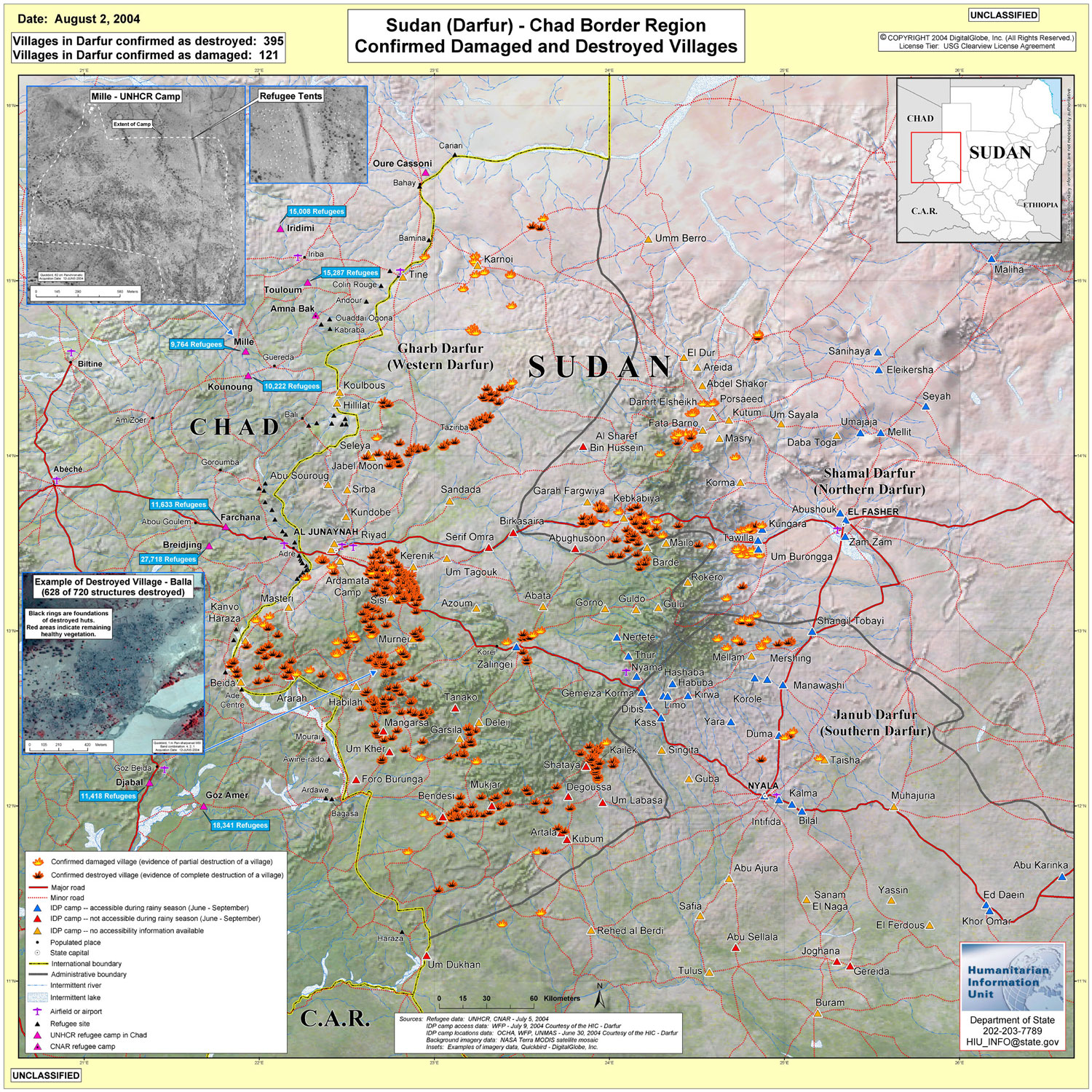
This map (http://upload.wikimedia.org/wikipedia/commons/5/54/Villages_destroyed_in_the_Darfur_Sudan_2AUG2004.jpg) shows the villages suffering now. Masalit in the west, Fur in the centre and Zaghawa in the north. The government uses the south-eastern Rizeigat tribe as their proxy ¨civilian¨ militias, the Janjaweed.
Mass graves, lost bodies.
As I write this, many many more fond memories come flooding back . People get up, pray, go to work, laugh and cry. A child dies - its parents cry. And I cry wondering what has become of my friends. The people of Darfur taught me a profound humility in the face of their adversity. The unrecorded history of the War Children of Darfur started many centuries ago and continues today.
Every Darfuri child has always been and remains a War Child.
Subscribe to:
Posts (Atom)