Tom Reynolds new book More Blood, More Sweat and Another Cup of Tea (ok, I know I've been posting on this all week - but he's a bit of a literary hero of mine) has an entry on the dangers of researching your medical condition the Internet.
One of the first things Kezia's consultant, John, warned us about when she was admitted to the RMCH was Internet quackery.
Fortunately, I am both well-educated (this is not meant as a boast!) and (in somethings)sensible so I only take information from cancer charity and scientific sources. And Nanda has been sensible and practical enough to follow John's prescribed advice.
It does not help from the IT data security aspect that companies (such as Google and Microsoft) are now offering to keep your health data and records online!
Showing posts with label Royal Manchester Children's Hospital. Show all posts
Showing posts with label Royal Manchester Children's Hospital. Show all posts
Thursday, June 11, 2009


Friday, March 20, 2009
Medical Update
Kezia had her routine check-up today. Didn't see our consultant but neutrophils at 2.85 which is acceptable. Down from last time.
Seemingly, the next appointment will be at the new RMCH in the centre of Manchester - she said Pendlebury was already showing signs of packing out.
Seemingly, the next appointment will be at the new RMCH in the centre of Manchester - she said Pendlebury was already showing signs of packing out.
Monday, January 7, 2008


Friday, November 30, 2007
Ethnicity and Inequality in the NHS II
The basic premise of the Cancer Research UK paper is that even though healthcare professionals may have gone through cultural sensitivity training, they feel inadequate and unconfident in their capability to deal with cultural differences. The fact that cultural sensitivity training discusses “cultures”, not individuals, may lead to stereotyping by practitioners – the woman behind the burqa is not an individual.
Training in the differences between cultures, the paper admits, remains essential but you cannot teach every healthcare professional about every culture they may come across. There is a need for healthcare professionals to be encouraged to view each patient or carer as an individual with their own experiences and value systems regardless of culture.
The paper also recommends, almost as a final aside, “Any steps must be integrated with other efforts to support intercultural communication and reduce misunderstandings caused by language and communication style”. I would thus extend such training to Language Line, the private sector interpreting service used by the NHS with hourly-paid interpreters.
Our first interpreter was a disgrace. From our ex-colonial power and because Nanda is black African we received every bit of second-hand tot clothing she could lay her hands on, every second-hand tot toy she could lay her hands on. Sorry luv (you patronized us so I will patronize you) – we can clothe our daughter, we can entertain her. Nanda might be black, she is not poor or ignorant. Nor is our daughter.
Our second interpreter, same language, white but not from the ex-colonial power was far more sympathetic.
Language Line (LL) interpreters also need a minimal knowledge of medical terminology and procedures. This lack will certainly inhibit the healthcare professional’s ability to interact with and respond to the patient/carer’s personal needs. Language Line needs to evaluate its interpreters, whether they are full-time (do they have any?) or freelance. Patient and practitioner response also need to be evaluated by both LL and the NHS … even though I think as a whole our response would be “we’re grateful for anything from the NHS …”.
LL, although an international company, works like an amateur private English-as–a-Foreign-Language School in a foreign country. The interpreters they call upon for the NHS do not have professional interpreting qualifications.
I would love to see the NHS-LL contract …
For Nanda, although her English is still poor (she is not a language learner in which she has a common trait with the UK white population), she learned the hospital and medical procedures relatively quickly, how to read the lab report, how to ensure hospital transport was booked etc. She soon dismissed interpreting services. Much of that, of course, has to with the amazing sensitivity of RMCH staff and in our case John, our consultant, and Teresa, our social-worker.
Training in the differences between cultures, the paper admits, remains essential but you cannot teach every healthcare professional about every culture they may come across. There is a need for healthcare professionals to be encouraged to view each patient or carer as an individual with their own experiences and value systems regardless of culture.
The paper also recommends, almost as a final aside, “Any steps must be integrated with other efforts to support intercultural communication and reduce misunderstandings caused by language and communication style”. I would thus extend such training to Language Line, the private sector interpreting service used by the NHS with hourly-paid interpreters.
Our first interpreter was a disgrace. From our ex-colonial power and because Nanda is black African we received every bit of second-hand tot clothing she could lay her hands on, every second-hand tot toy she could lay her hands on. Sorry luv (you patronized us so I will patronize you) – we can clothe our daughter, we can entertain her. Nanda might be black, she is not poor or ignorant. Nor is our daughter.
Our second interpreter, same language, white but not from the ex-colonial power was far more sympathetic.
Language Line (LL) interpreters also need a minimal knowledge of medical terminology and procedures. This lack will certainly inhibit the healthcare professional’s ability to interact with and respond to the patient/carer’s personal needs. Language Line needs to evaluate its interpreters, whether they are full-time (do they have any?) or freelance. Patient and practitioner response also need to be evaluated by both LL and the NHS … even though I think as a whole our response would be “we’re grateful for anything from the NHS …”.
LL, although an international company, works like an amateur private English-as–a-Foreign-Language School in a foreign country. The interpreters they call upon for the NHS do not have professional interpreting qualifications.
I would love to see the NHS-LL contract …
For Nanda, although her English is still poor (she is not a language learner in which she has a common trait with the UK white population), she learned the hospital and medical procedures relatively quickly, how to read the lab report, how to ensure hospital transport was booked etc. She soon dismissed interpreting services. Much of that, of course, has to with the amazing sensitivity of RMCH staff and in our case John, our consultant, and Teresa, our social-worker.
Wednesday, November 21, 2007
Ethnicity and Inequality in the NHS
One of the (now not so) new Secretary of State for Health's stated aims for the NHS was to reduce health service provision inequalities whether regional, age-group, ethnic etc.
A major paper by researchers, sponsored by Cancer Research UK, looking at the perceptions of healthcare professionals into their own interactions with patients and carers of cultures other than their own, has just been published and makes interesting reading.
A conclusion in the abstract of the paper is “A shift away from a cultural expertise model toward a greater focus on each patient as an individual may help.”.
Friday, November 9, 2007
To Be or Not to Be
The Central Manchester and Manchester Children's University Hospital Trust (CMMCUH), currently a Primary Care Trust, is making a bid to become a Foundation Trust.
I summarised the official definitions of the various types of financial/administrative status of the different “units” of our “socialised” healthcare system here. Sorry international readers for having to make you navigate the ways and means of English health service bureaucracy .
Although I somewhat agree that the CMMCUH's Royal Manchester Children's Hospital, Booth Hall Children's Hospital etc need to be replaced as old Victorian “unsanitary”, “difficult-to-maintain” buildings, I am now somewhat cynical about the trust's motive in building new children's (and other) facilities on its principal site in central Manchester – first, plan a brand-spanking new hospital, become a foundation trust and then sell-off the desirable suburban old (and, I will say, to-our-mental-health, comforting) hospital sites and keep the profits. And the government will say “oooh ... you're in the black, so we don't need to give you so much money”.
UNISON argues that 20,000 members will not effectively represent the views of the entire population. Manchester, Greater Manchester and the entire North-west, which the CMMCUH serves, has a population of several million. Who are going to be those most disposed and most available to become “members”?
Middle-class, literate caucasians ...
And the pathetic consultation questionnaire had to be submitted by 30 September.
So, Dear Readers, should I or should I not become a member?
Monday, October 29, 2007
Medical Update Illustrated
Back in Africa after two weeks with Kezia, Jaime and Nanda in the UK
During the two weeks in
Below is a small illustrated narrative of a routine visit to the hospital, an amalgamation of the two visits.
First, let’s have a photo of Tom, the volunteer ambulance driver, who picks up in

Tom gave me some interesting and confusing “insights” into the inner-workings of the NHS – he is paid by one Trust, his ambulance control is another Trust, most of his work is carting children to and from the RMCH, another Trust, from other Trusts. That is just “managing” a volunteer!
He’s also doubtful about the new
So when Kezia arrives, first stop is the pathology lab to have her finger pricked (i.e. a blood sample taken). The waiting room is a play room:

And good as gold she has her finger pricked:

… and gets five stickers for the effort.


Up to clinic. First a physical exam – chest, mouth, lymph nodes, spleen etc.

Then this week we have a Vincristine injection via a Cannula (a needle into the vein, attached to a tube, into which the syringe fits). Kezia doesn’t complain at all, and the doctor and nurse say she is always a pleasure to treat given that it took three adults to hold the last child down and they are absolutely knackered.


Nanda admits that she has “bribed” Kezia – you”ll get a present if you don’t cry!

Sunday, October 21, 2007
What's in a name?
The Chairman of the Central Manchester and Manchester Children's University NHS Trust thinks that by giving us, the punters, a choice in the name of the new Manchester children's hospital, we will feel a sense of "ownership". He added "The new hospital will be at the heart of the community in Greater Manchester and the north west - it will belong to the people who live here and we want them to feel a sense of pride in it".
So the Choices are:
a) Royal Manchester Children's Hospital
b) Manchester Children's Hospital
c) Other - please suggest.
Option a) will really maintain the status quo, Option b) is really for vehement anti-monarchists, Option c) I cannot see what others have suggested.
And given that anyone, in the whole wide world, can vote on the new name at the new hospital's website, then I would encourage my international readership to vote so the decision is truly local!
Choices ?
Pathetic.
So the Choices are:
a) Royal Manchester Children's Hospital
b) Manchester Children's Hospital
c) Other - please suggest.
Option a) will really maintain the status quo, Option b) is really for vehement anti-monarchists, Option c) I cannot see what others have suggested.
And given that anyone, in the whole wide world, can vote on the new name at the new hospital's website, then I would encourage my international readership to vote so the decision is truly local!
Choices ?
Pathetic.
Wednesday, July 11, 2007
I'm a smoker
John at NHS Blog Doctor has posted many times about the stupidity of smoking and the paucity of treatment for the often resulting lung cancer on the NHS. And obviously all the other health problems it can cause or exacerbate. I do not disagree with him one iota …
… but I am a smoker.
My mum died full of life aged 70 years from a stroke. Got up one morning, got washed, brushed her teeth, dressed and collapsed on the landing. Discovered by a friend with whom she was going for a pub lunch She was overweight, smoked some, drank some and was on the verge of completing her Ph.D. She tried stopping smoking again and again. At least she didn´t suffer. Just dropped.
Shame she didn´t see or even know of her grand-daughter. Shame her Ph.D. thesis almost completed, was never submitted. (On sex education, or lack of, provision in primary and secondary schools in the local education authority - if anyone is interested, I think I can rustle up a copy).
P.S. Kezia seemed alot chirpier yesterday - must be coming down from the Dexamethasone.
Wednesday, June 27, 2007
Hospital Food
Dontcha just love it?
A lighter post - TV chef Loyd Grossman, who for five years headed the NHS's Better Food in Hospital's programme to improve the quality and nutritional value of food provided in hospitals, has complained about the government's lack of commitment to the project.
The Better Hospital Food website is certainly appetising. Baked Salmon with Lemon, Garlic and Parsley Crust, Grilled mackerel with Tomato, Ginger and Thyme Sauce, Chicken Kofta Curry, Ratatouille Tart with Mozarella, Pasta, Ham and White Bean Bake - you can even download the recipes to try out at home.
However, I couldn't find any Fish and Chips with Baked Beans. In fact, no mention of children's recipes at all. I seem to recall that there has been a similar move in the UK to make school dinners more nutritional with limited success given children's preferences for junk food.
And given that Kezia developed food obsessions due to the chemotherapy for such things as chips, roast chicken crisps etc.
In fact the catering facilities at RMCH weren't bad. The hospital cafeteria had a varied menu of hot dishes and a variety of cold snacks. Ok after four weeks being resident in the hospital I could notice the same dishes being repeated over. On the ward resident parents had access to a kitchen with cooker, microwave, refridgertaor and freezer at all times except when the childrens' food was being served and in the parents' accommodation attached to the ward there was a similarly equipped kitchen. Tea and coffee, yoghurts, biscuits etc were available in the ward kitchen.
Update: Do see Lucia's comment - yes, young adult dietary requirements or even, let us say, tastes are somewhat different to those of small children.
A lighter post - TV chef Loyd Grossman, who for five years headed the NHS's Better Food in Hospital's programme to improve the quality and nutritional value of food provided in hospitals, has complained about the government's lack of commitment to the project.
The Better Hospital Food website is certainly appetising. Baked Salmon with Lemon, Garlic and Parsley Crust, Grilled mackerel with Tomato, Ginger and Thyme Sauce, Chicken Kofta Curry, Ratatouille Tart with Mozarella, Pasta, Ham and White Bean Bake - you can even download the recipes to try out at home.
However, I couldn't find any Fish and Chips with Baked Beans. In fact, no mention of children's recipes at all. I seem to recall that there has been a similar move in the UK to make school dinners more nutritional with limited success given children's preferences for junk food.
And given that Kezia developed food obsessions due to the chemotherapy for such things as chips, roast chicken crisps etc.
In fact the catering facilities at RMCH weren't bad. The hospital cafeteria had a varied menu of hot dishes and a variety of cold snacks. Ok after four weeks being resident in the hospital I could notice the same dishes being repeated over. On the ward resident parents had access to a kitchen with cooker, microwave, refridgertaor and freezer at all times except when the childrens' food was being served and in the parents' accommodation attached to the ward there was a similarly equipped kitchen. Tea and coffee, yoghurts, biscuits etc were available in the ward kitchen.
Update: Do see Lucia's comment - yes, young adult dietary requirements or even, let us say, tastes are somewhat different to those of small children.
Thursday, June 14, 2007
Royal Manchester Children's Hospital
I see that the Paediatric Oncology Unit at the Royal Manchester Children's Hospital now has a webpage here. And as all the staff are listed, I'll 'fess up to who our consultant and social worker are - John Grainger and Theresa Romagnuolo.
The page is part of a larger cancer information site run by the Central Manchester and Manchester Children's Hospitals Trust.
The page is part of a larger cancer information site run by the Central Manchester and Manchester Children's Hospitals Trust.
Tuesday, May 8, 2007
Something seems to have gone wrong today
Kezia and Nanda are still stuck in the hospital. Kezia hasn't been seen by a doctor since Sunday but seemingly the chicken pox is cured. Numerous calls to Nanda, the Borchardt Clinic and my brother. The Borchardt Clinic told me they would get a doctor to her twice, then they couldn't hear me. Nanda has been up to see them - same message. Then I had my brother ring and he spoke to both the Clinic and Heywood Ward where they are "interned". He got the same message.
Kafka-esque - you would have thought with bed shortages they would be keen to get rid of her!
Anyway, my brother is picking Jaime up from school and then going to the hospital. Hopefully, they will be ready for discharge. Update tomorrow.
Update: They finally got out of hospital around 18:00.
Kafka-esque - you would have thought with bed shortages they would be keen to get rid of her!
Anyway, my brother is picking Jaime up from school and then going to the hospital. Hopefully, they will be ready for discharge. Update tomorrow.
Update: They finally got out of hospital around 18:00.
Wednesday, April 18, 2007
Patientline III
Lucia tries to draw me into the Patientline debate - I refuse to be drawn!
However, I will make some observations on the Borchardt Ward at the Royal Manchester Children's Hospital. Each bed has a Patientline terminal and yes, televison for children is free. However, each bed also has a regular donated televison set (with headphones).
Concerning telephone sets there are two regular payphones, one at the entrance to the ward and one in the middle of the ward that accepts both incoming and outgoing calls. Given a relatively relaxed mobile phone policy as well and the fact that the younger children have little need for phone services, then it is little surprise that Patientline will not be making a profit on Borchardt Ward, and I suspect throughout the RMCH.
However, I will make some observations on the Borchardt Ward at the Royal Manchester Children's Hospital. Each bed has a Patientline terminal and yes, televison for children is free. However, each bed also has a regular donated televison set (with headphones).
Concerning telephone sets there are two regular payphones, one at the entrance to the ward and one in the middle of the ward that accepts both incoming and outgoing calls. Given a relatively relaxed mobile phone policy as well and the fact that the younger children have little need for phone services, then it is little surprise that Patientline will not be making a profit on Borchardt Ward, and I suspect throughout the RMCH.
Wednesday, November 15, 2006
Royal Manchester Children's Hospital #1
I'll say #1 as I'm sure I'll have more to say about this marvelous institution another day. I'll get onto the rest of our personal narrative later, and also details of treatment.
The Royal Manchester Children's Hospital (RMCH) is divided into two branches – Pendlebury and Booth Hall. Don't know the latter but the former dates back to 1873. (There's a plan design on the wall of the cafeteria as well as a letter of praise from Florence Nightingale). Clearly, it's been added onto as time has gone by – but it remains a warm Victorian masterpiece. (Probably would be great for urban adventurers – but maybe you should wait until it closes). I wish I knew who the architect was.
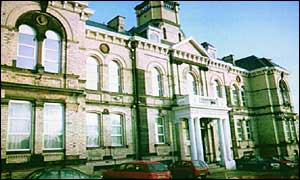
Unfortunately, it comes with all the problems of ageing Victorian buildings – vermin. Manchester now plans a new mega-complex hospital which will replace the two children's hospitals and much more. No more comment right now as I don't know much more about it. But it seems a shame.
It's a children's hospital – half creche/kindergarten/nursery school (whatever you call it)/half hospital. The medical equipment seems to get hidden behind all the toys, paintings, balloons, posters, awards for being a brave patient, TVs, Playstations, pedal-cars, dolls, stuffed animals etc etc. You name it – if you're child wasn't sick, it would be their paradise.
Older children must feel out of place. The hospital accepts upto 16th birthday. The hospital recognises that older children, or I should say young adults, have different needs and get their own room.(H. who you will meet later on – filled her room with school photos, received visits from teenage school colleagues, teachers etc). The hospital has its own school, so illness permitting education can continue including taking public examinations. Clowns visit, activities organised, music sessions etc etc.
First impressions – everyone is on first name terms. From the top consultant thro' to the student nurse thro' to the porter. The whole philosophy of the hospital is to make us at ease as much as possible. Stressed-out children are not going to be helped by stressed-out parents.
Each ward has a parents' suite consisting of three or so bedrooms, a kitchen and bathrooms. So during the four weeks we were there I would sleep in one of these and Nanda with Kezia on the ward. During the initial admission period in the hospital, both parents are allowed to stay - which in case was a godsend as Nanda doesn't speak English. Later admissions only one parent can stay - although I think if there were special circumstances, such as language, they would probably be flexible.The ward itself has a kitchen which parents can use when patients' meals aren't being served. There are also clothes-washing facilities, a playroom, a large outdoor play space (with tricycles, pedalcars etc) and of course bathroom/toilets for the patients.
Patients get three meals a day with a reasonable selection, parents make their own or use the cafeteria.
(Photo courtesy of the BBC).
Subscribe to:
Posts (Atom)


